


What Is an Air Quality Index?
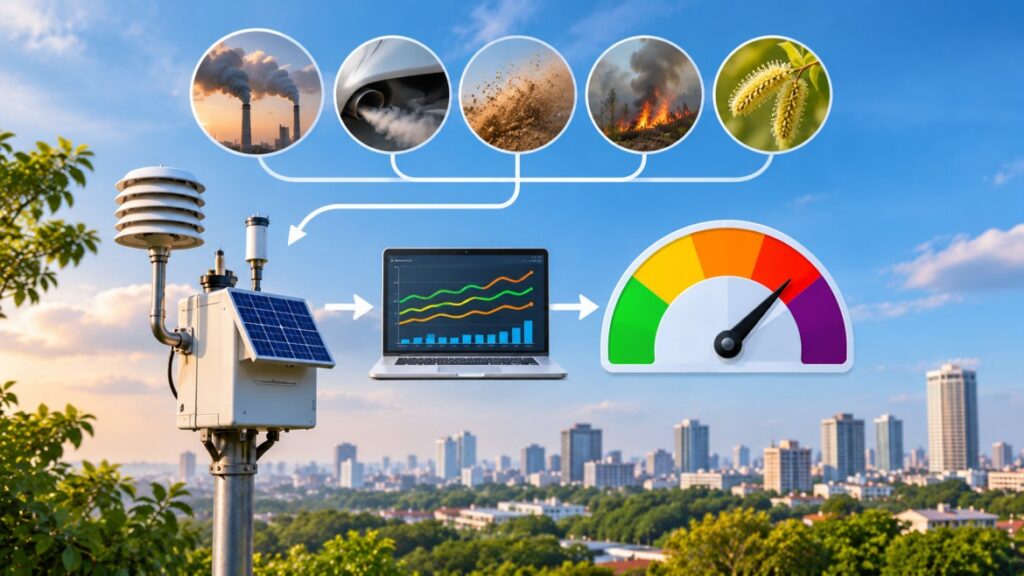
Air pollution is not always visible, and understanding its potential effects on human health requires more than simply observing the environment. This is where the Air Quality Index (AQI) becomes important.
An Air Quality Index (AQI) is a numerical indicator used to communicate air quality conditions and their potential implications for human health. It translates scientific measurements of air pollutants into a scale that regulators, policymakers, and the general public can understand.
Rather than presenting complex pollutant measurements separately, an AQI provides a simplified way to communicate air quality conditions and support decisions about environmental management and public health protection.
However, air quality indices are not calculated in the same way everywhere. Countries and regulatory agencies use different methodologies, pollutants, averaging periods, and reporting scales depending on their environmental standards and public health priorities.
Understanding these differences is important when interpreting air quality information, particularly in regions such as Trinidad and Tobago, where industrial activity, transportation emissions, and environmental conditions influence air quality.
How Does an Air Quality Index Work?
An Air Quality Index converts measured pollutant concentrations into numerical values or categories that describe air quality conditions.
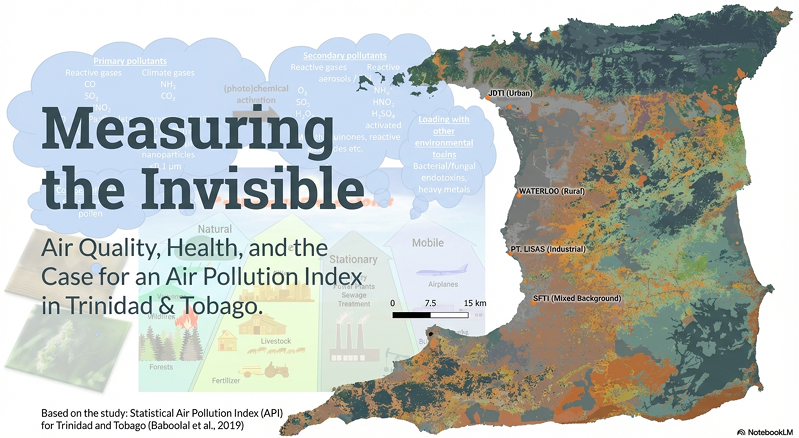
According to Baboolal, Stoute, Chadee, and Balladin (2019), air quality indices are developed using mathematical relationships between environmental measurements, pollutant characteristics, and potential health effects.
Depending on the methodology, an index may incorporate several parameters, including:
- Concentrations of gaseous pollutants.
- Airborne particulate matter.
- Meteorological conditions, such as wind speed and direction.
- Temperature and precipitation.
- Other environmental variables relevant to the selected methodology.
Not every AQI includes all these parameters. The pollutants and environmental measurements used depend on the particular index being developed.
Some systems assess several pollutants independently and report the highest calculated value. Others combine pollutant concentrations using weighted or unweighted mathematical approaches.
The purpose is to translate scientific information into a form that is easier to interpret and communicate.
Why Is the Air Quality Index Important?
Air quality measurements can be technically complex, particularly when several pollutants are present simultaneously.
An AQI simplifies this information into a numerical value or category that can help users recognise changes in air quality and identify potential health concerns. For environmental regulators, air quality indices can support the evaluation of pollution conditions and the communication of appropriate advisories.
For the public, they provide accessible information that may help guide decisions about outdoor activities and exposure to air pollution.
Air quality indices have been used for several decades, particularly in industrialised countries where environmental regulation and public health protection are closely connected.
As Baboolal et al. (2019) explain, composite air quality indices can help make complex scientific measurements more useful for environmental decision-making and public communication.
Their usefulness lies not only in simplifying environmental data, but also in providing a consistent framework for interpreting pollution levels over time.
What Pollutants Are Measured in an Air Quality Index?
The pollutants included in an AQI depend on the reporting system and the environmental standards used by the relevant authority.
Common pollutants include:
| Pollutant | Description |
|---|---|
| Particulate matter (PM2.5 and PM10) | Small airborne particles that can originate from combustion, vehicle emissions, industrial processes, dust, and other sources |
| Sulphur dioxide (SO₂) | A gaseous pollutant associated with the combustion of sulphur-containing fuels and certain industrial activities |
| Nitrogen dioxide (NO₂) | A pollutant commonly associated with fuel combustion, including vehicle exhaust and industrial processes |
| Carbon monoxide (CO) | A gas produced through incomplete combustion of carbon-containing fuels |
| Ground-level ozone (O₃) | A secondary pollutant formed through chemical reactions involving other air pollutants in sunlight |
These pollutants have different chemical properties and potential health implications.
Consequently, AQI methodologies must account for differences in pollutant concentrations, applicable standards, and relevant exposure periods.
How Is an Air Quality Index Calculated?
Air quality indices are calculated using measurements collected over specified periods.
Depending on the pollutant and reporting framework, these measurements may be averaged over one hour, eight hours, 24 hours, or another defined period. The resulting concentrations are then converted into index values according to the calculation method established by the relevant regulatory authority.
There are two broad approaches discussed in the original research:
1. Composite or Weighted Air Quality Indices
Some methodologies combine measurements from several pollutants into a single index. The pollutants may be assigned equal or different weights depending on their characteristics, the relevant environmental standards, and the calculation framework. This approach is intended to represent multiple dimensions of pollution within one numerical indicator.
However, the selection and weighting of variables influence the resulting index, creating methodological differences between systems.
2. Highest Pollutant Sub-Index Methods
Other systems calculate separate index values for individual pollutants and report the highest sub-index as the overall AQI. The United States Environmental Protection Agency uses this type of approach.
This methodology identifies the pollutant producing the highest index value under the relevant calculation rules.
Although it provides a useful indication of the dominant pollutant concern, it does not directly represent all potential combined or interactive effects of exposure to multiple pollutants. Each method therefore has advantages and limitations, making it important to understand which calculation approach has been used when interpreting an AQI value.
How Do Air Quality Index Systems Differ Around the World?
Air quality indices have developed differently across countries as environmental monitoring, regulatory standards, and scientific knowledge have evolved.
Researchers have evaluated these methodologies to understand how they represent pollutant concentrations and communicate potential health implications.
Baboolal et al. (2019), drawing on studies by Bishoi, Prakash and Jain (2009), Tiwari (2015), and Wong et al. (2012), compared several international approaches to air quality indexing.
Comparison of International Air Quality Indices
| Air Quality Index / Authority | Pollutants or factors | Calculation approach |
|---|---|---|
| Coefficient of Haze, United States (Green, 1966) | SO₂ and particulate matter measured as smoke shade | Weighted combination of two pollution indicators, using a 0–100 scale |
| Oak Ridge AQI (Thom & Ott, 1976) | SO₂, NO₂, particulate matter, CO, and photochemical oxidants | Weighted combination based on pollutant concentrations relative to standards |
| Taiwan AQI research (Lohani, 1984) | Multiple air pollution measurements | Statistical factor analysis used to develop an index and compare calculation approaches |
| US Pollution Standards Index (1999) | SO₂, NO₂, particulate matter, CO and O₃ | Uses the highest pollutant sub-index, generally reported on a 0–500 scale |
| Canada AQI (pre-2007) | Pollutants included in the historical Canadian index | Historical index using a 0–100 scale |
| Canadian Air Quality Health Index (AQHI) | O₃, NO₂ and PM2.5 | Combines estimates of health risk from pollutants using a rolling three-hour average |
| India’s revised AQI framework | CO, NO₂, PM10, PM2.5, SO₂, O₃ and NH₃, among others | Uses the highest pollutant sub-index, calculated using defined concentration breakpoints |
| China Air Pollution Index | SO₂, NO₂ and PM10 in the historical system discussed | Uses the highest pollutant sub-index in relation to defined pollutant concentration breakpoints |
| Buke & Kone (2016) | SO₂, NO₂ and PM10 | Combines equally weighted pollutant variables normalised against target values |
Source: Adapted from the comparison presented by Baboolal et al. (2019). The table summarises historical and research-based AQI methodologies rather than presenting every system as a current national standard.
This comparison illustrates why air quality index values cannot always be interpreted in the same way across different jurisdictions. The pollutants included, their averaging periods, calculation methods, and associated standards influence the reported values.
Consequently, an AQI number should always be interpreted according to the specific system used to produce it.
What Do Air Quality Index Levels Mean?
The meaning of an AQI value depends on the reporting framework.
Under the United States Environmental Protection Agency’s AQI system, values generally range from 0 to 500. Higher values indicate increasing levels of air pollution and greater potential health concern.
The US system uses six categories to communicate air quality conditions.
| US AQI value | Air quality category | General interpretation |
|---|---|---|
| 0–50 | Good | Air quality is satisfactory, with little or no associated pollution risk |
| 51–100 | Moderate | Air quality is generally acceptable, although unusually sensitive individuals may experience some effects |
| 101–150 | Unhealthy for Sensitive Groups | Sensitive populations may experience health effects |
| 151–200 | Unhealthy | Health effects may occur among the general population, with greater risks for sensitive groups |
| 201–300 | Very Unhealthy | Increased health risks across the population |
| 301–500 | Hazardous | Serious health warnings and heightened risks for the population |
Source: US EPA Air Quality Index Basics. These categories apply to the US AQI and should not automatically be applied to other national indices.
For comparison, Canada’s Air Quality Health Index (AQHI) uses a different scale, commonly reported from 1 to 10+, with categories ranging from low to very high health risk.
This reinforces the importance of identifying the reporting system before interpreting a numerical air quality value.
What Is the Difference Between an AQI and an API?
The terms Air Quality Index (AQI) and Air Pollution Index (API) are used in environmental monitoring and reporting.
Both refer to numerical systems used to communicate air quality or pollution conditions.
However, the terminology does not establish a universal direction for interpreting the numerical scale.
In the commonly used US AQI, a higher value indicates greater pollution and health concern. Some other historical or specialised systems use different scales and classifications.
The calculation methodology and associated reporting guidance must therefore be considered before interpreting the index.
How Does the Air Quality Index Help Protect Public Health?
One of the main purposes of an AQI is to make environmental measurements useful for public health protection.
Air pollution can affect different population groups in different ways, depending on the pollutants present, their concentrations, and the duration of exposure.
Groups that may be particularly vulnerable include:
- Children and older adults.
- People with existing respiratory conditions.
- Individuals with cardiovascular diseases.
- People who are especially sensitive to particular air pollutants.
Air quality indices allow environmental and public health authorities to communicate conditions that may require additional precautions.
For example, when air quality deteriorates, authorities may issue advisories recommending reduced outdoor exposure or changes to physical activities for vulnerable groups. These advisories may be communicated through websites, television, radio, public information displays, and other communication channels.
By presenting scientific measurements in an accessible format, air quality indices help individuals and institutions make more informed decisions about potential exposure to air pollution.
Why Is Air Quality Monitoring Important in Trinidad and Tobago?
For Trinidad and Tobago, understanding air quality is particularly relevant because of the country’s industrial activities, transportation systems, and exposure to natural airborne pollutants. Air quality monitoring can provide information about pollutant concentrations in different locations and help identify changes over time.
An appropriate AQI methodology can then translate selected monitoring measurements into information that is more accessible to policymakers, regulators, and the public.
However, an AQI does not replace detailed environmental measurements. Individual pollutant concentrations, monitoring methods, exposure conditions and applicable environmental standards remain important when assessing air quality at a particular location.
Organisations seeking to understand environmental conditions at their premises may also need more detailed assessments than a publicly reported index can provide.
For information about environmental assessment in Trinidad and Tobago, visit Air Science and Environmental Quality Ltd.
Conclusion: Why Understanding the Air Quality Index Matters
The Air Quality Index plays an important role in communicating air pollution conditions and supporting public health protection.
By translating scientific measurements into numerical values or categories, it makes complex environmental information easier to understand and use. However, AQI methodologies are not identical across countries. Different pollutants, calculation approaches, averaging periods, and environmental standards can produce different index values. Understanding these differences is essential for interpreting air quality information accurately.
An AQI is most valuable when it is based on reliable monitoring data, an appropriate scientific methodology, and clear public communication.
For governments, environmental professionals, businesses and communities, it provides a useful means of understanding air pollution conditions and recognising situations where further investigation or precautionary action may be necessary.
To enquire about environmental assessment requirements, contact Air Science and Environmental Quality Ltd.
Frequently Asked Questions
What is an Air Quality Index in simple terms?
An Air Quality Index is a numerical scale that communicates how clean or polluted the air is and indicates potential health concerns associated with measured pollutant levels.
Does a higher AQI mean better or worse air quality?
Under the widely used US AQI system, a higher value means worse air quality and greater potential health concern. Other indices may use different scales, so their interpretation depends on the reporting methodology.
What is considered a good AQI?
Under the US AQI system, values from 0 to 50 are classified as Good. Values above 100 indicate increasing health concerns, particularly for sensitive populations.
How is the AQI calculated?
AQI values are calculated from pollutant concentration measurements using established formulas and concentration breakpoints. Some methodologies combine multiple pollutants, while others report the highest individual pollutant sub-index.
What is the difference between air quality monitoring and an AQI?
Air quality monitoring measures pollutant concentrations in the environment. An AQI translates selected measurements into a numerical scale or category that communicates air quality conditions and potential health concerns.
Scientific References
The original article draws primarily on the research of Baboolal and colleagues, alongside studies comparing air quality indices across countries.
Primary research
Other references cited in the original article
- Bishoi, Prakash and Jain (2009). Research comparing air pollution index calculation methods.
- Tiwari (2015). Research examining air pollution indices and calculation approaches.
- Wong et al. (2012). Research relating to Canada’s Air Quality Health Index.
- Central Pollution Control Board (2014). India’s national Air Quality Index framework.
- United States Environmental Protection Agency (2019). Air Quality Index reporting guidance.
Additional official reference
United States Environmental Protection Agency. Air Quality Index Basics.